
Note: This is a guest post by Emily Hue, c/o Keith Miyake
I’m a big fan of Foodjimoto so posting this one is a dream come true. I’m Keith’s partner’s, Emily. You guys know Keith. He and his sister, Lauren grew up with the Fujimotos. He’s that all around camping buddy, PhD student, and handy fixer of things. It’s been a long, cold winter in New York, where we live, so it’s nice to dream of a time when it was warm. When an ice cream dessert drink made sense.
To me, faluda is a Burmese/Indian dessert drink that ushered in summer time with my family after seemingly long rainy springs in Brooklyn. Made up of ice cream, bread pudding, and various kinds of gelatin and scented with rosewater, it's not for the faint of heart when it comes to sweetness. For special occasions such as birthdays or New Year's, this drink served as an incentive for me and my cousins to sit down, behave, and eat all the food on our plates just to get to the dessert.
After doing a bit of research on faluda, I found it's not only popular in Burma, India, and Pakistan, but also in Iran where it’s called Paloodeh. Not to mention the various diasporic populations that still make this drink to remind them of home.
The joy of faluda is that you can add whatever fixings you want to it according to taste. This recipe includes some specialty items. You can get them at a South Asian supermarket or dry goods store. Since we did our shopping near the Foodjimoto studio, a.k.a. the Fujimoto’s kitchen, we were able to find a South Asian market called India Emporium, located in a strip mall in La Puente, at 17365 E. Valley Blvd., La Puente, CA 91744 where we got these goodies. If you ask for these ingredients by name and follow up with “They’re for Faluda,” a knowing gentleman in the front will be nice enough to ring you up.
These are the ingredients you need from the South Asian market:
Rooh Afza: A non alcoholic citric concentrate that acts like a syrup used to flavor icy drinks including milkshakes and sherbet drinks throughout South/Southeast Asia and the Middle East.
Rosewater: like it sounds, rose-scented water that brings out the flavor of the faluda so that it’s not just sweet to eat, but sweet to smell.
Basil Seeds: you soak them over night and they puff up into 1 cm shaped beads that add the tiniest crunch to a mixed drink. Some folks prefer them instead of sago pearls.
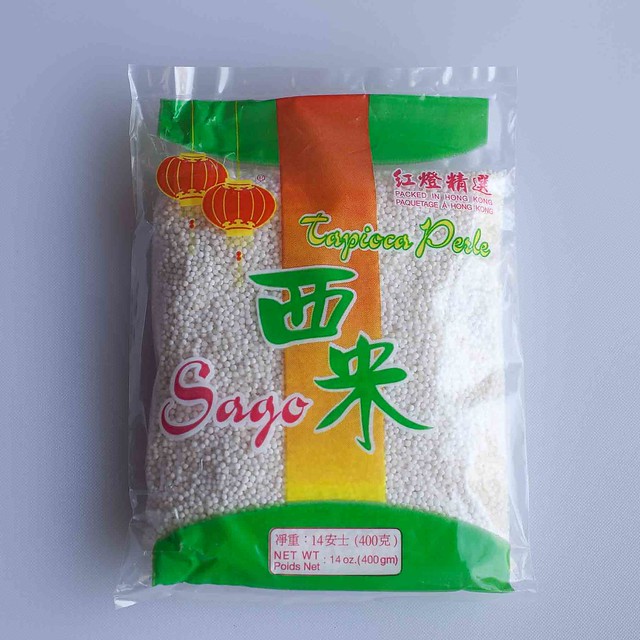
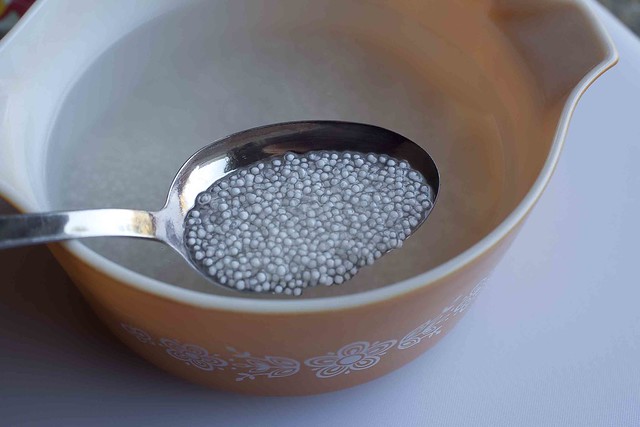
Sago Pearls (pictured below): small starchy balls, similar to tapioca pearls, only smaller. They are used to add texture to desserts throughout much of Asia, as in the ABC drink found in Malaysian snack shops.
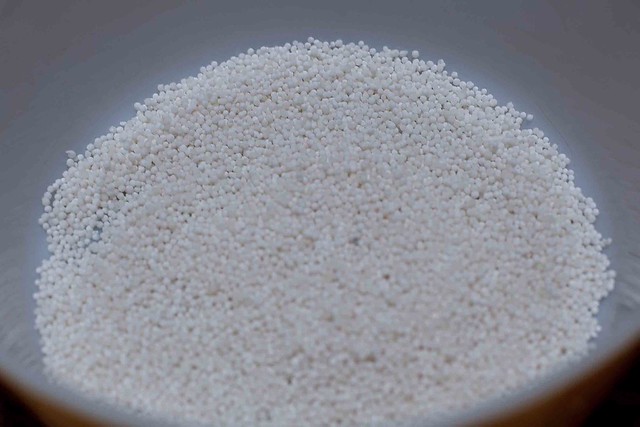
Here’s an up-close shot of the sago pearls so you can see how small they are!
Here are all of the ingredients you will need:
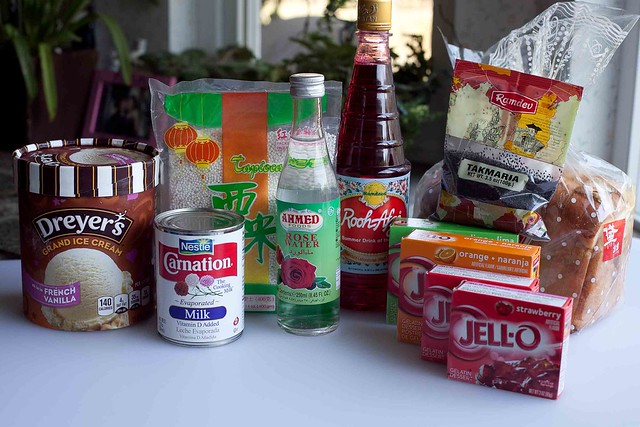
Some people like to include raisins; agar agar can be used instead of jello for less sweetness; basil seeds and sago pearls are interchangeable, or both can be used together. For me, if it’s a slightest bit too sweet then it’s perfect. This one is adapted from my mother’s recipe. I prefer no raisins and used jello instead of agar agar—they have similar prep. But flavored jello is sweeter compared to agar agar which is more for texture than for taste. Also, I include pictures of basil seeds in case you want to use them. I left them out the final recipe this time around because they need to soak overnight.
Bread pudding:
4 eggs
8 T sugar
1/2 can of evaporated milk (half of a 6 oz Carnation’s can is fine)
1/2 c. of milk
10 slices of white bread (crusts off)
Faluda:
Bread pudding as described above
2 packets of Jell-O (whichever flavors/colors you want, I stuck with Orange and Lime); can substitute agar agar
Vanilla ice cream (1 – 2 scoops per serving)
1/4 packet of sago pearls (approx. 100g dry measure)
Rooh Afza (approx. 1 t. per serving)
Rose Weater (approx. 1/2 t. per serving)
Raisins (optional; 1-2 t. per serving)
Preheat the oven up to 375°F
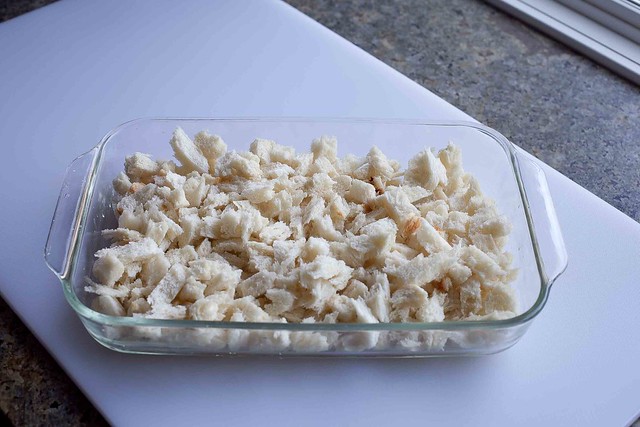
Take the crust off the slices of bread and then tear the slices into 2 inch pieces. Place these bread pieces in a 9"x12" baking dish.
Whisk together 4 eggs, mix in the evaporated milk and regular milk, and then add the sugar. Pour the egg mix over the bread pieces.
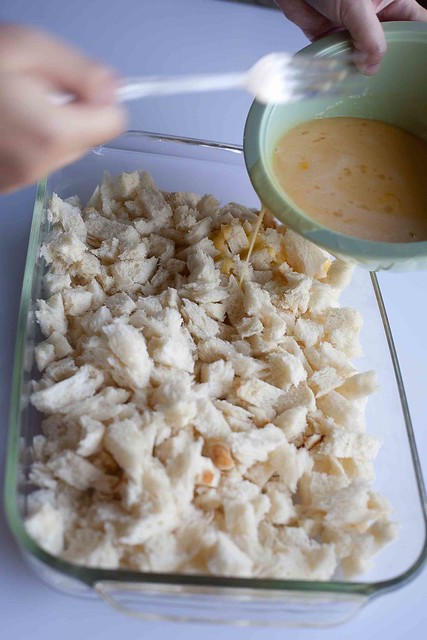
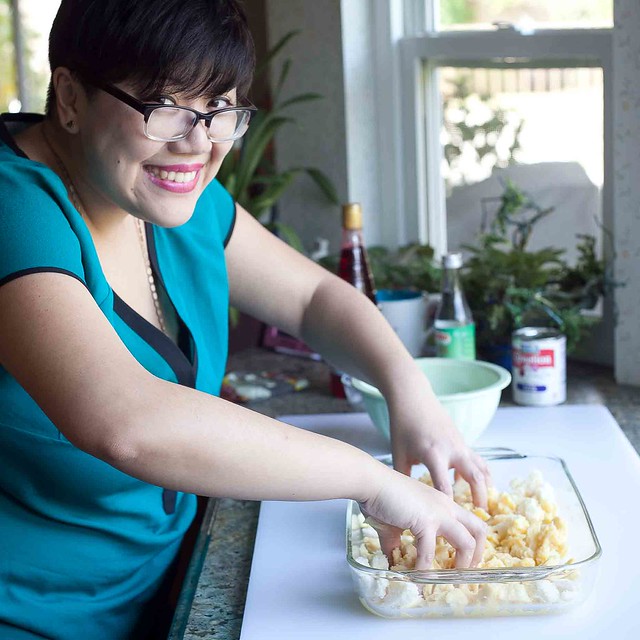
Use a spoon or your hands to fully combine the bread and egg mixture. Allow the bread to soak for 2 additional minutes.
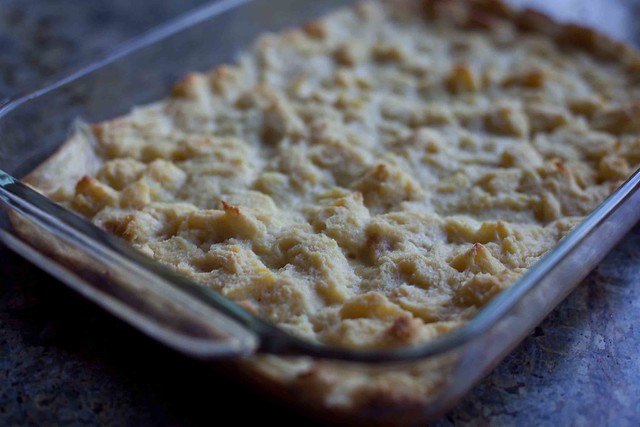
Bake at 375°F for approximately 40 minutes or until golden brown. Remove the bread pudding from the oven and set aside to cool. After it has cooled, slice it into chunks small enough to fit in your serving cups.
While the bread pudding’s in the oven enter into sago phase. Pour the sago pearls into a prep bowl.
Fill up a saucepan halfway with water, set to boil. When the water is at a rolling boil, add the the sago pearls. Boil them for 1 minute and then transfer everything to a heat-safe bowl.
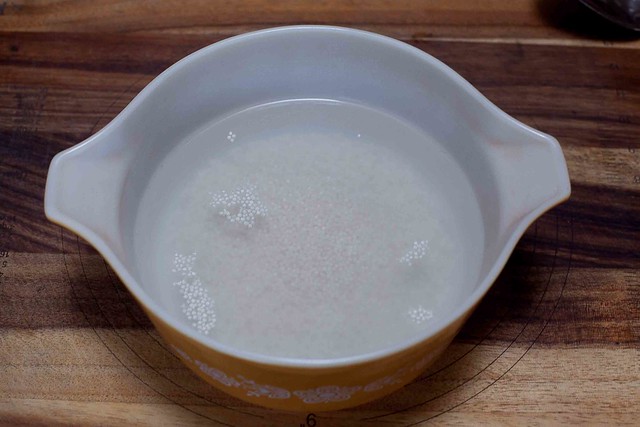
Cover with foil and allow it to sit for about 45 minutes. You’ll know they're ready when the sago pearls are mostly transparent. You should taste a couple to check. They should be slightly firm but not chalky. If you come up upon some chalkiness you may want to drain off the water as it cools and try to pour boiling water over the sago pearls one more time and let the pearls sit a while longer. When they are the right texture/transparency, transfer them to a sieve and rinse with cold water.
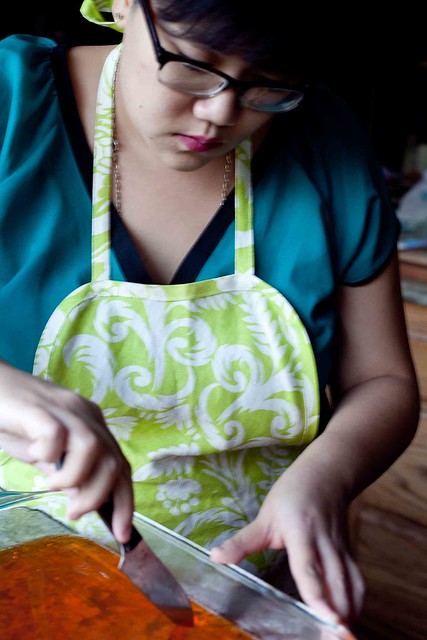
While you are waiting for the sago to soak, boil some additional water for the Jell-O. Follow the directions on the packet. You should have two to three colors/flavors at your disposal. I ended up with a lot of extra jello this time. I’d suggest only preparing half a Jell-O package unless you want to eat the rest of it separately.
Visualize this as the layering of a parfait.
Add 2 or 3 tablespooons of sago pearls
Drizzle half a teaspoon of rose water into the glass
Drizzle a teaspoon of Rooh Afza into the glass.
Place a few cubes/chunks of bread pudding into the glass onto top of the sago pearls
A few tablespoons of Jell-O on top of this
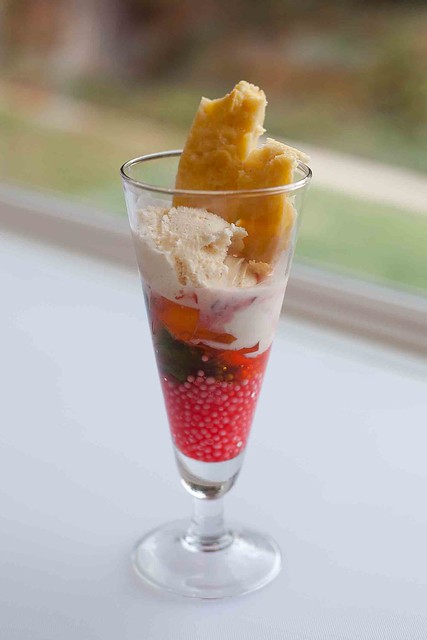
Top off with two small-ish scoops of ice cream.
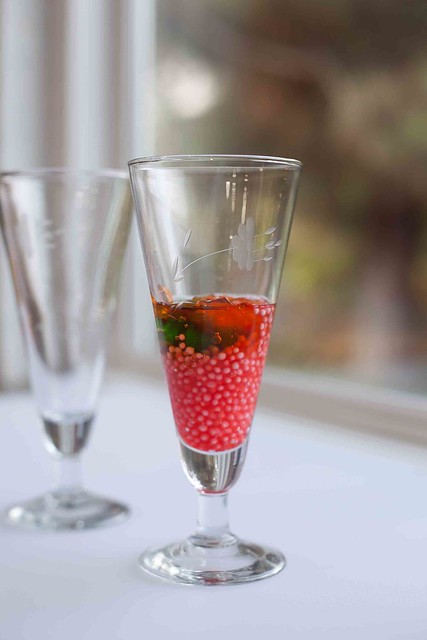
You can play with the ratio according to your taste, rooh afza makes things sweeter as do more jello and ice cream.
The last step is probably my favorite. As my mom would say, "YOU HAVE TO MIX IT!" Use a spoon or straw to mix the drink so that all the ingredients seem evenly dispersed. You should end up with a pinkish hue. Swirls of deeper pink are fine. Enjoy!
I’m a big fan of Foodjimoto so posting this one is a dream come true. I’m Keith’s partner’s, Emily. You guys know Keith. He and his sister, Lauren grew up with the Fujimotos. He’s that all around camping buddy, PhD student, and handy fixer of things. It’s been a long, cold winter in New York, where we live, so it’s nice to dream of a time when it was warm. When an ice cream dessert drink made sense.
To me, faluda is a Burmese/Indian dessert drink that ushered in summer time with my family after seemingly long rainy springs in Brooklyn. Made up of ice cream, bread pudding, and various kinds of gelatin and scented with rosewater, it's not for the faint of heart when it comes to sweetness. For special occasions such as birthdays or New Year's, this drink served as an incentive for me and my cousins to sit down, behave, and eat all the food on our plates just to get to the dessert.
After doing a bit of research on faluda, I found it's not only popular in Burma, India, and Pakistan, but also in Iran where it’s called Paloodeh. Not to mention the various diasporic populations that still make this drink to remind them of home.
The joy of faluda is that you can add whatever fixings you want to it according to taste. This recipe includes some specialty items. You can get them at a South Asian supermarket or dry goods store. Since we did our shopping near the Foodjimoto studio, a.k.a. the Fujimoto’s kitchen, we were able to find a South Asian market called India Emporium, located in a strip mall in La Puente, at 17365 E. Valley Blvd., La Puente, CA 91744 where we got these goodies. If you ask for these ingredients by name and follow up with “They’re for Faluda,” a knowing gentleman in the front will be nice enough to ring you up.
These are the ingredients you need from the South Asian market:
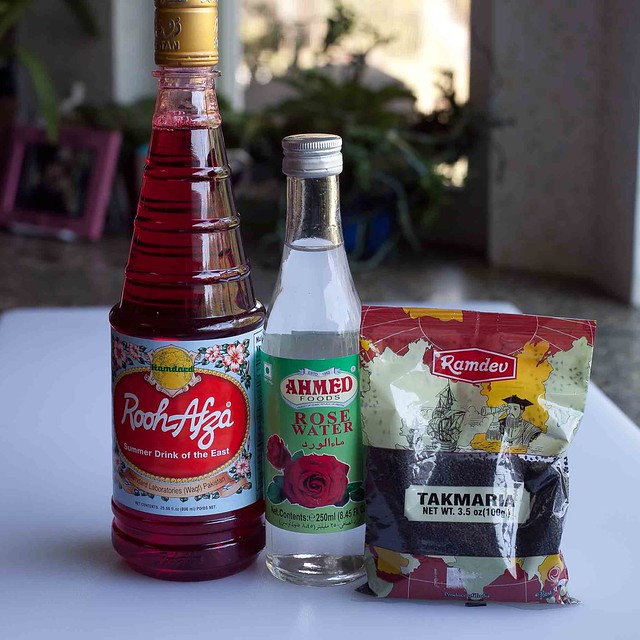 |
From left to right: Rooh Afza, rose water, and basil seeds.
|
Rosewater: like it sounds, rose-scented water that brings out the flavor of the faluda so that it’s not just sweet to eat, but sweet to smell.
Basil Seeds: you soak them over night and they puff up into 1 cm shaped beads that add the tiniest crunch to a mixed drink. Some folks prefer them instead of sago pearls.
Sago Pearls (pictured below): small starchy balls, similar to tapioca pearls, only smaller. They are used to add texture to desserts throughout much of Asia, as in the ABC drink found in Malaysian snack shops.
Here’s an up-close shot of the sago pearls so you can see how small they are!
Here are all of the ingredients you will need:
Some people like to include raisins; agar agar can be used instead of jello for less sweetness; basil seeds and sago pearls are interchangeable, or both can be used together. For me, if it’s a slightest bit too sweet then it’s perfect. This one is adapted from my mother’s recipe. I prefer no raisins and used jello instead of agar agar—they have similar prep. But flavored jello is sweeter compared to agar agar which is more for texture than for taste. Also, I include pictures of basil seeds in case you want to use them. I left them out the final recipe this time around because they need to soak overnight.
Ingredients
Makes 4 to 6 servings (use approx. 10 oz glasses)Bread pudding:
4 eggs
8 T sugar
1/2 can of evaporated milk (half of a 6 oz Carnation’s can is fine)
1/2 c. of milk
10 slices of white bread (crusts off)
Faluda:
Bread pudding as described above
2 packets of Jell-O (whichever flavors/colors you want, I stuck with Orange and Lime); can substitute agar agar
Vanilla ice cream (1 – 2 scoops per serving)
1/4 packet of sago pearls (approx. 100g dry measure)
Rooh Afza (approx. 1 t. per serving)
Rose Weater (approx. 1/2 t. per serving)
Raisins (optional; 1-2 t. per serving)
Preheat the oven up to 375°F
Take the crust off the slices of bread and then tear the slices into 2 inch pieces. Place these bread pieces in a 9"x12" baking dish.
Whisk together 4 eggs, mix in the evaporated milk and regular milk, and then add the sugar. Pour the egg mix over the bread pieces.
Use a spoon or your hands to fully combine the bread and egg mixture. Allow the bread to soak for 2 additional minutes.
Bake at 375°F for approximately 40 minutes or until golden brown. Remove the bread pudding from the oven and set aside to cool. After it has cooled, slice it into chunks small enough to fit in your serving cups.
While the bread pudding’s in the oven enter into sago phase. Pour the sago pearls into a prep bowl.
Fill up a saucepan halfway with water, set to boil. When the water is at a rolling boil, add the the sago pearls. Boil them for 1 minute and then transfer everything to a heat-safe bowl.
Cover with foil and allow it to sit for about 45 minutes. You’ll know they're ready when the sago pearls are mostly transparent. You should taste a couple to check. They should be slightly firm but not chalky. If you come up upon some chalkiness you may want to drain off the water as it cools and try to pour boiling water over the sago pearls one more time and let the pearls sit a while longer. When they are the right texture/transparency, transfer them to a sieve and rinse with cold water.
While you are waiting for the sago to soak, boil some additional water for the Jell-O. Follow the directions on the packet. You should have two to three colors/flavors at your disposal. I ended up with a lot of extra jello this time. I’d suggest only preparing half a Jell-O package unless you want to eat the rest of it separately.
Directions to plate/serve:
Start with a clear glass, approx. 10 oz. This is not a hard and fast rule I just think it looks decadent. My favorite part of making faluda is drizzling in the Rooh Afza and watching that neon red syrup turn everything else in the drink gradations of pink. A clear glass makes it easier to witness the magic.Visualize this as the layering of a parfait.
Add 2 or 3 tablespooons of sago pearls
Drizzle half a teaspoon of rose water into the glass
Drizzle a teaspoon of Rooh Afza into the glass.
Place a few cubes/chunks of bread pudding into the glass onto top of the sago pearls
A few tablespoons of Jell-O on top of this
Top off with two small-ish scoops of ice cream.
You can play with the ratio according to your taste, rooh afza makes things sweeter as do more jello and ice cream.
The last step is probably my favorite. As my mom would say, "YOU HAVE TO MIX IT!" Use a spoon or straw to mix the drink so that all the ingredients seem evenly dispersed. You should end up with a pinkish hue. Swirls of deeper pink are fine. Enjoy!
 Print This Recipe


